
Tegenungan Waterfall
Complete Tegenungan Waterfall Information Guide
Tegenungan Waterfall is a powerful lowland waterfall in Kemenuh, Gianyar, around 10 km south of central Ubud, with viewpoints above the gorge, a steep stairway to the river and swimming when water conditions are suitable.
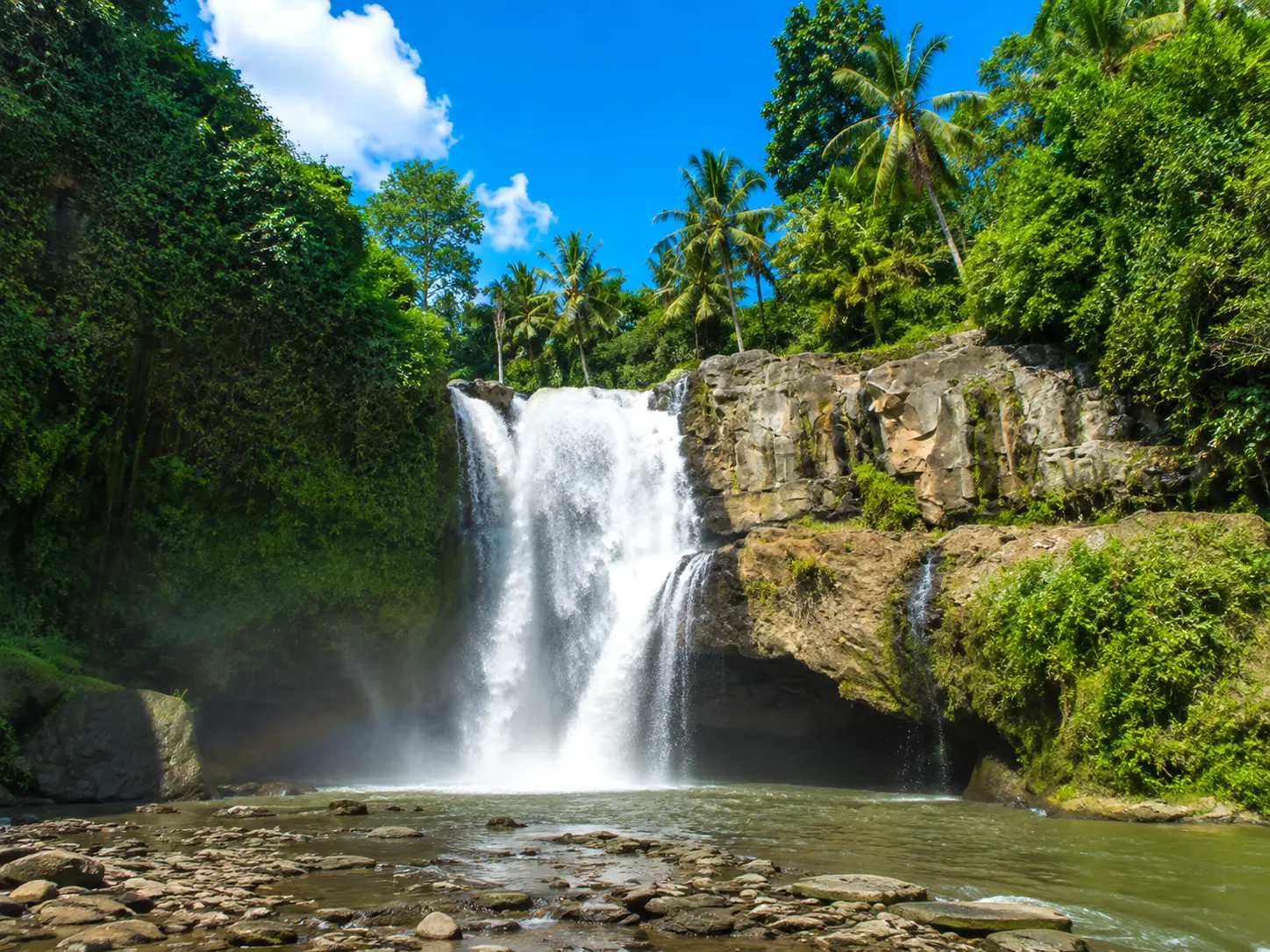
TEGENUNGAN WATERFALL
Explore This Guide
Jump directly to the information you need.
Tegenungan Waterfall Quick Facts
| Practical detail | What to expect |
|---|---|
| Location | Kemenuh, Sukawati, Gianyar Regency |
| Distance from Ubud | About 10 km south of central Ubud; often around 20–30 minutes by road in normal traffic |
| Published opening hours | Usually 06:30–18:30 daily |
| Adult entrance | Current published information varies; allow roughly IDR 20,000–30,000 per adult |
| Child entrance | Published information commonly uses a reduced child rate |
| Best time | Early morning, soon after opening |
| Typical visit | About 1–2 hours, depending on swimming, photographs and how far you descend |
| Physical effort | Moderate; the climb back up the steep staircase is the main effort |
| Swimming | Possible when river conditions permit; never assume swimming will be safe on the day |
| Accessibility | Upper viewpoints are easier; the river level is not suitable for wheelchairs or strollers |
| Advance booking | Not normally needed for simple gate admission; useful for tours, transport or a combined sightseeing day |
What Type of Visit Suits You?
| If you want… | What to plan |
|---|---|
| A quick scenic stop | Use the upper viewpoints and allow around 45–60 minutes |
| The full waterfall experience | Descend to river level and allow around 1–2 hours |
| To swim | Go after a period of relatively dry weather and check conditions before entering |
| A quieter experience | Arrive soon after opening and avoid busy weekends or peak tour times |
| A completely undeveloped jungle waterfall | Choose another waterfall; Tegenungan is convenient but highly developed |
Is Tegenungan Waterfall Worth Visiting?
Yes, if you want a dramatic waterfall close to Ubud without committing to a long mountain trek.
Tegenungan is particularly useful for visitors who want to include a waterfall in an Ubud or central Bali sightseeing day. The road approach is straightforward, there are developed visitor facilities and you can see the waterfall from above before deciding whether to walk down.
It is a good fit when:
- You are staying around Ubud: It is one of the easiest substantial waterfalls to reach from the area.
- You have limited time: A visit can fit into a half-day or full-day central Bali route.
- You want viewpoints as well as river access: You do not have to descend immediately to see the waterfall.
- You are comfortable with stairs: The river-level experience is much better if you are willing to make the climb back up.
It may be better to skip it when:
- You want solitude: Tegenungan is a well-developed and frequently busy attraction.
- You expect untouched jungle: Shops, cafés, photo areas and other tourist facilities are part of the experience.
- Clear swimming water is essential: The Petanu River can become brown and fast after rainfall.
- Steep stairs are a problem: Reaching the river requires a significant descent and climb.
Tegenungan vs Blangsinga: Same Waterfall, Different Entrances
Tegenungan Waterfall and Blangsinga Waterfall are two names used for the same waterfall, approached from opposite sides of the river valley.
This causes unnecessary confusion on maps and tour listings. The Tegenungan approach is associated with the Kemenuh side, while the Blangsinga approach reaches the same waterfall from the opposite side.
The two sides have their own road access, parking and ticket arrangements. Do not assume that purchasing admission on one side automatically gives you entry through the other entrance.
| Entrance | Best for | Important point |
|---|---|---|
| Tegenungan / Kemenuh side | Most first-time visitors and the classic Tegenungan approach | Busier and more commercially developed |
| Blangsinga side | A different viewpoint and visitors approaching from the eastern side | Separate access and ticket arrangements |
MAIN KEMENUH APPROACH
Tegenungan Entrance
This is the most familiar entrance for visitors following signs for Tegenungan Waterfall.
You arrive above the gorge, with parking, ticketing, food and visitor facilities concentrated around the upper area. From there, viewpoints overlook the waterfall before the path descends towards the river.
Choose this side when you simply want the standard first-time Tegenungan visit and do not have a specific reason to approach from Blangsinga.
OPPOSITE RIVER APPROACH
Blangsinga Entrance
Blangsinga is not a second waterfall; it is another approach to the same cascade.
The entrance is reached by a different road and provides a different perspective across the valley. It can make sense when your driver is approaching from the eastern side or when you specifically want the Blangsinga viewpoint.
Confirm the entrance before your driver drops you off. Driving from one entrance to the other is not the same as simply crossing a few metres inside the attraction.
Planning Your Tegenungan Waterfall Visit
Decide your entrance, arrival time and whether you intend to descend to the river before planning the rest of your day.
Opening Hours & Entrance Fees
Published opening hours are generally around 06:30–18:30 daily, while current adult entrance information varies between approximately IDR 20,000 and IDR 30,000.
Entrance charges can change and different published sources do not always show the same figure. Budget roughly IDR 20,000–30,000 per adult and check the posted gate price when you arrive.
Bring Indonesian rupiah in small denominations. Parking, changing facilities, private attractions, food, drinks and other optional services may involve separate charges.
When Is the Best Time to Visit?
Early morning soon after opening is usually the best choice for lower temperatures, fewer visitors and more flexibility if water conditions are poor.
- Early morning: Usually the most comfortable combination of cooler air and lighter crowds.
- Late morning: Convenient for day tours but generally busier and hotter on the climb back up.
- Afternoon: Still possible, but allow enough time to descend and return before closing.
- After heavy rain: Visit for the view if the site is open, but treat swimming as uncertain.
The waterfall is attractive with both low and high flow, but the experience changes significantly. Recent upstream rainfall can matter more than the month printed on the calendar.
How Long Should You Allow?
Allow around 1–2 hours for a normal visit that includes the viewpoints, the descent to the river and time at the base.
- 45–60 minutes: Upper viewpoints plus a relatively quick look around.
- 1–1.5 hours: Viewpoints, descent to the river, photographs and climb back.
- 1.5–2 hours: A relaxed visit with swimming when conditions permit.
- Longer: Add time if you stop for a meal or use separate private facilities nearby.
The walk down is not the main issue for most visitors. The climb back up in Bali’s heat and humidity is what usually determines how long the visit feels.
How Do You Get to Tegenungan Waterfall?
A private driver, car or scooter is the simplest way to reach Tegenungan Waterfall.
The waterfall is in Kemenuh, Sukawati, Gianyar, roughly 10 km south of central Ubud. In normal traffic the drive from Ubud is often around 20–30 minutes, although congestion, ceremonies and road conditions can make the journey longer.
- Private driver: The most practical option when combining Tegenungan with Ubud, rice terraces, temples or other attractions during the same day.
- Scooter: Practical for confident riders who are already comfortable riding in Bali traffic.
- Ride-hailing: Can work for a simple visit, but return-driver availability and waiting time should not be assumed when your schedule is tight.
- Organised tour: Check whether waterfall admission is included or paid separately at the entrance.
Confirm whether your navigation app or driver is taking you to the Tegenungan/Kemenuh entrance or the Blangsinga entrance, because they approach the same waterfall from different sides.
If you need a private driver for Tegenungan or a wider Bali sightseeing day, BestBaliDrivers.com provides information and booking options for private drivers, airport transfers and local transport in Bali.
How Difficult Are the Stairs?
The descent is manageable for many reasonably mobile visitors, but the return climb can be tiring in the heat.
Published visitor guides commonly describe roughly 150–170 concrete steps, although counts differ according to the exact route and what is included. Handrails and landings help, but wet surfaces can become slippery.
- Knee or mobility problems: Consider enjoying the upper viewpoints rather than committing to the full descent.
- Wheelchairs: General river-level access is not wheelchair accessible.
- Strollers: A stroller is not practical for reaching the waterfall base.
- Hot weather: Climb slowly, rest when needed and carry drinking water.
Facilities & What Should You Bring?
Tegenungan is considerably more developed than many Bali waterfalls, so basic visitor facilities are available around the attraction.
You can normally find some combination of parking, toilets, changing facilities, food, drinks, shops and photo areas. Quality and additional charges vary.
Bring
- Footwear with grip: Steps and rocks can become slippery.
- Drinking water: Particularly useful for the climb back up.
- Swimwear and towel: If you intend to enter the water.
- Dry change of clothes: Useful after swimming or heavy waterfall spray.
- Waterproof pouch or dry bag: Protect phones and other electronics.
- Cash: Keep small rupiah notes for tickets and optional local charges.
- Sun protection: Some upper areas and the return climb can be exposed.
Do not leave passports, large amounts of cash or expensive electronics unattended while swimming.
Swimming, River Conditions & Safety
Swimming can be part of a Tegenungan visit, but the Petanu River is natural moving water and conditions are not guaranteed.
Can You Swim at Tegenungan Waterfall?
Usually yes when water levels and currents are suitable, but swimming should be treated as conditional rather than guaranteed.
The river pool around the waterfall is popular for cooling off, especially after relatively dry weather. Conditions can change quickly after rainfall upstream, even when it is not raining directly over the waterfall.
- Stay away from the main plunge point: Falling water and current are strongest close to the cascade.
- Follow barriers and local instructions: Do not enter areas that have been closed.
- Watch your footing: Rocks can be uneven and coated with algae.
- Do not judge only by other swimmers: Make your own conservative decision based on the current and your ability.
- Supervise children continuously: Natural river water is not equivalent to a swimming pool.
How Do Rain and the Seasons Affect the Waterfall?
Recent rainfall upstream has more immediate importance than the season alone.
During Bali’s generally drier months, roughly April to October, the river is often calmer and the stairs are more comfortable to use. During the wetter months, roughly November to March, stronger flow, brown water and slippery access become more likely.
| Condition | What it means for your visit |
|---|---|
| Several dry days | Often better water clarity and more comfortable swimming conditions |
| Light recent rain | Visit may still be normal, but check the river before entering |
| Heavy rain upstream | Expect stronger current, muddy water and possible swimming restrictions |
| Very high or fast water | Enjoy the view and stay out of the river |
| Wet stairs | Slow down and use footwear with reliable grip |
The waterfall can actually look more powerful after rain, so poor swimming conditions do not automatically mean the visit itself has no value.
Is Tegenungan Waterfall Suitable for Children?
Yes for many families, provided the children can manage the stairs and adults supervise them closely around the river.
- Young children: Hold hands on steep or wet sections and keep them within reach near the water.
- Strollers: Do not plan to take a stroller down to river level.
- Swimming: Skip it when the current looks strong, water levels are high or access has been restricted.
- Heat: The climb back up can be much harder for children than the walk down.
- Footwear: Avoid smooth-soled shoes on wet steps and rocks.
Families who do not want the full descent can still enjoy views from the upper part of the attraction.
What Is the Tegenungan Waterfall Experience Actually Like?
Expect an impressive natural waterfall inside a highly developed visitor attraction rather than an isolated jungle trek.
At the Top
The upper area has the easiest viewpoints and most of the visitor infrastructure. This is where you can decide whether the heat, stairs and current conditions justify walking down.
On the Way Down
The route uses developed steps rather than a long jungle trail. Commercial facilities and photo points are part of the approach, so visitors looking for a completely untouched waterfall should adjust their expectations.
At River Level
The scale and sound of the waterfall become much stronger near the river. Spray, wet rocks and uneven footing are normal. Swimming may be possible, but the waterfall is still worthwhile when you stay on shore.
The Climb Back
This is the part many visitors underestimate. Take your time, especially around midday. There is no advantage in rushing the climb simply to keep to an overly tight sightseeing schedule.
What Can You Combine With Tegenungan Waterfall?
Tegenungan combines most naturally with an Ubud or central Bali day because it sits south of Ubud rather than deep in Bali’s northern mountains.
Tegenungan + Ubud Monkey Forest
This works well when you want one nature stop outside Ubud and one central-Ubud attraction without spending most of the day driving.
Tegenungan + Tegalalang Rice Terrace
This creates a broader landscape-focused day, but Tegalalang is north of Ubud, so allow for traffic through or around the Ubud area rather than treating the two attractions as neighbours.
Tegenungan + Cultural Stops
A waterfall visit can also be combined with temples, craft villages or another cultural experience. Keep the schedule realistic: the waterfall takes longer when you descend, swim and rest rather than viewing it only from above.
Frequently Asked Questions
Do You Need to Book Tegenungan Waterfall in Advance?
Not normally for simple entrance admission. Visitors can generally buy their ticket when they arrive. Advance arrangements are more useful when you want a private driver, organised tour or a day combining several attractions.
Do You Need a Guide?
No guide is normally required for a straightforward visit. The attraction has developed paths and stairs. A driver or guide becomes more useful when Tegenungan is one stop within a wider central Bali itinerary.
Can You Visit Without Going Down to the River?
Yes. Upper viewpoints allow visitors to see the waterfall without completing the full stair descent. This is useful for people with limited time or reduced mobility.
Do You Need Swimwear?
Only if you intend to enter the water. Bring a towel and dry clothes if swimming is part of the plan. Changing facilities may be available, but their condition and charges can vary.
Is There a Special Dress Code?
General waterfall viewing does not normally require temple clothing. However, parts of the surrounding area have local religious significance, so follow signs, respect restricted areas and comply with any local dress instructions if entering a sacred space.
Can You Visit During Bali’s Rainy Season?
Yes, but the experience can be very different. The waterfall may be more powerful while the river is browner and faster, the steps are wetter and swimming may be unsuitable or restricted. Recent rainfall should influence your decision more than the month alone.
Related Experiences
These guides are useful when building a wider Ubud or central Bali day around Tegenungan Waterfall.
A central-Ubud nature and cultural attraction that combines easily with Tegenungan when you want two very different experiences in one day.
A useful next guide when extending the day north of Ubud for rice-terrace scenery, walking paths and the wider Tegalalang landscape.
Useful when you want to understand Balinese water purification as a cultural and religious practice rather than treating every sacred water site as a swimming attraction.
Final Advice
Choose Tegenungan when you want a substantial waterfall close to Ubud and are comfortable trading solitude for easy access and developed facilities.
Arrive early, confirm which entrance your driver is using, bring cash and footwear with grip, and decide whether to swim only after seeing the river conditions yourself. If recent rainfall has made the water fast or brown, enjoy the waterfall from shore rather than forcing the swimming experience.
Explore the Best Bali 4 U Network
Continue through the Best Bali 4 U Network when you need booking options, wider Bali information, healthcare guidance or practical local planning beyond this Tegenungan Waterfall guide.
Questions About This Guide?
Contact the editorial team if you have a question about the guide, have noticed information that should be corrected or updated, or would like to share reliable local knowledge, suggestions or feedback.